
Neo-Organic Sanctuary
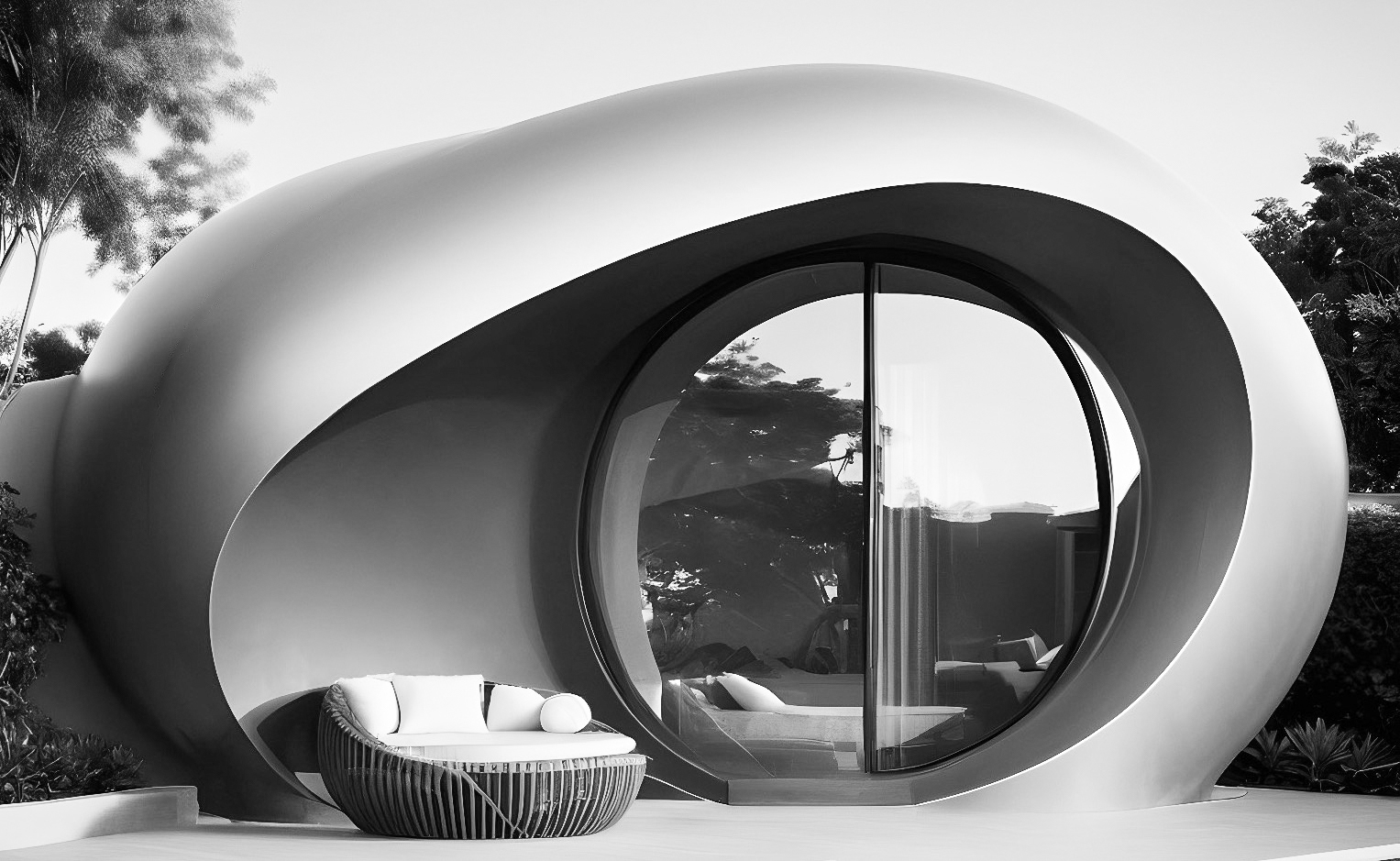
"Neo-Organic Sanctuary" represents a revolutionary approach to residential architecture that draws inspiration from natural forms and biological structures. This private retreat challenges conventional notions of shelter by creating a seamless dialogue between built form and natural environment.
The structure's distinctive pod-like form with its large circular aperture creates a unique framing device for the surrounding landscape. The curved, continuous surfaces eliminate the traditional distinction between walls, floor, and ceiling, instead creating a holistic spatial experience that flows from interior to exterior.
The design responds directly to its environment, with the form oriented to optimize views, natural ventilation, and passive solar performance. The integration of outdoor living spaces further blurs the boundary between architecture and landscape, creating a series of transitional zones that mediate between enclosed and open areas.
The design process began with extensive site analysis and biomimetic research, studying natural structures that achieve maximum efficiency with minimal material. Advanced computational modeling techniques were employed to develop the complex geometries while ensuring structural integrity and constructability.
The structure utilizes a high-performance concrete shell system that allows for the seamless, monolithic expression while providing excellent thermal performance. The material palette is deliberately restrained, emphasizing the sculptural qualities of the architecture and allowing the surrounding landscape to provide natural color and texture.
"Neo-Organic Sanctuary" represents SP DEVELOPMENTS' commitment to exploring new paradigms for residential architecture that prioritize experiential quality and environmental integration. The project challenges conventional construction methods and spatial organizations, proposing instead a more intuitive and responsive approach to creating human habitat.
The project has received international recognition for its innovative approach to residential design and serves as a prototype for future explorations in biomorphic architecture. It demonstrates how advanced computational design and construction techniques can be harnessed to create living environments that respond to both human needs and environmental contexts in novel ways.