
Organic Pod
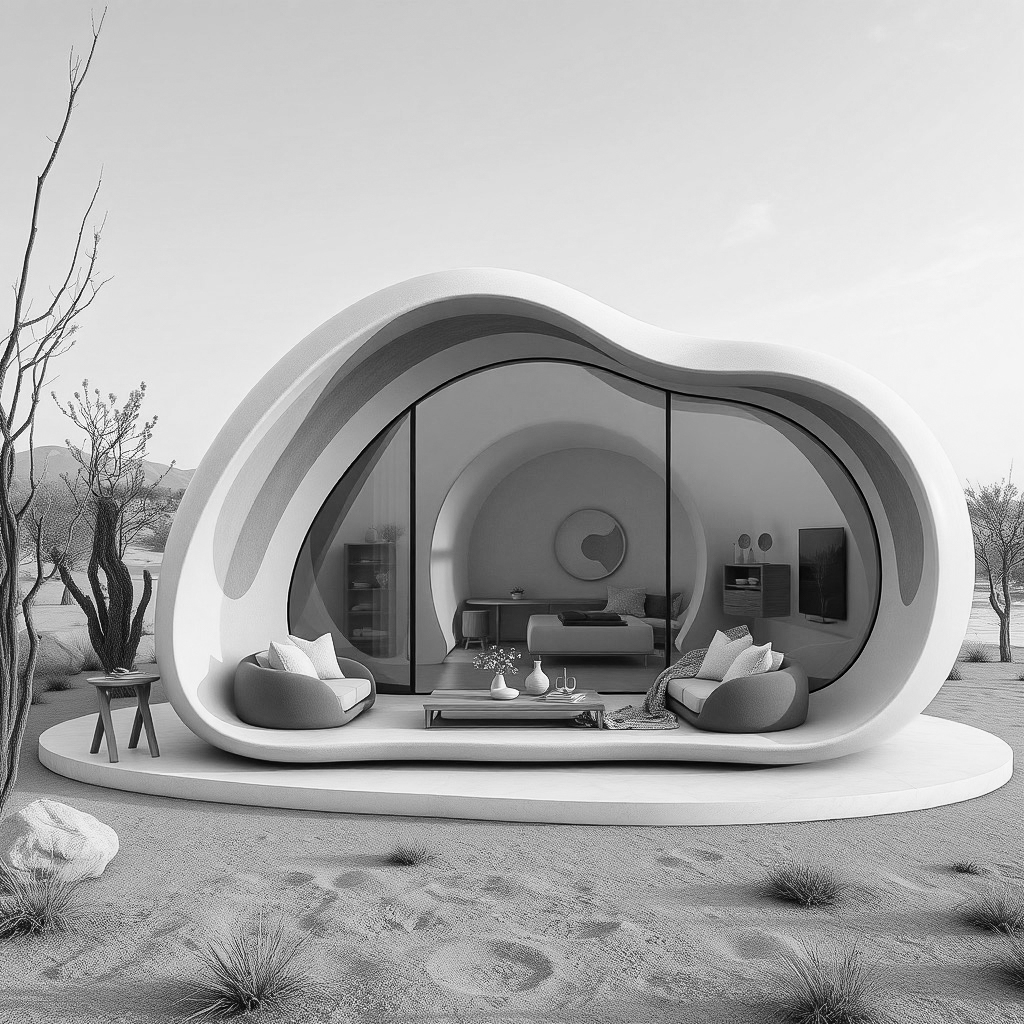
"Organic Pod" represents a revolutionary approach to small-scale residential architecture that reimagines the relationship between built form and natural environment. This compact dwelling unit challenges conventional notions of shelter through its fluid, continuous form that seems to emerge from the landscape itself.
The structure's distinctive curved silhouette creates a protective enclosure while the large glass opening establishes a powerful connection to the surrounding desert landscape. The design eliminates traditional architectural elements such as corners, straight walls, and right angles, instead creating a continuous spatial experience that flows seamlessly from exterior to interior.
The pod's form creates natural divisions between living zones without the need for internal walls, allowing for an open, flexible interior that can adapt to different needs. The curved glass facade frames panoramic views while the sheltered outdoor living area extends the usable space beyond the enclosed interior.
The design process began with studies of natural forms and how they respond to environmental forces. Advanced computational modeling and fabrication techniques were employed to develop the complex geometries while ensuring structural integrity and constructability. The form was carefully calibrated to optimize passive environmental performance, including natural ventilation and solar shading.
The pod utilizes a high-performance composite shell system that allows for the seamless, monolithic expression while providing excellent thermal insulation. The interior features a restrained palette of natural materials and soft furnishings that complement the curved architecture, creating a serene environment that focuses attention on the framed landscape views.
"Organic Pod" represents SP DEVELOPMENTS' exploration of how compact architecture can deliver spatial richness and emotional resonance. The project demonstrates that small-scale interventions can have a significant impact when designed with sensitivity to both human experience and environmental context.
The pod serves as a prototype for future explorations in micro-architecture that prioritize quality over quantity, offering an alternative to conventional approaches to residential design. Its success lies in creating a space that feels both intimate and expansive, sheltered yet connected to nature.